Download Ebook Still Counting the Dead: Survivors of Sri Lanka's Hidden WarBy Frances Harrison
Download Ebook Still Counting the Dead: Survivors of Sri Lanka's Hidden WarBy Frances Harrison
You can alter thing of how reading will provide you better choice. Yeah, Still Counting The Dead: Survivors Of Sri Lanka's Hidden WarBy Frances Harrison is a book developed by a specialist writer. You could take this sort of publication in this site. Why? We provide the billions kinds and brochures of the books on the planet. So, actually, it is not only this publication. You could find other book kinds to be yours. The means is very straightforward, locate the web link that we give and obtain guide quicker. Constantly attempt to be the initial person to read this publication is very enjoyable.
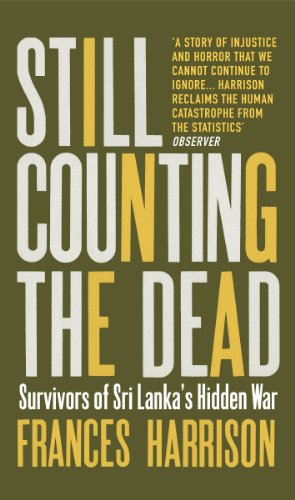
Still Counting the Dead: Survivors of Sri Lanka's Hidden WarBy Frances Harrison

Download Ebook Still Counting the Dead: Survivors of Sri Lanka's Hidden WarBy Frances Harrison
Still Counting The Dead: Survivors Of Sri Lanka's Hidden WarBy Frances Harrison. Haggling with reading habit is no need. Checking out Still Counting The Dead: Survivors Of Sri Lanka's Hidden WarBy Frances Harrison is not kind of something marketed that you could take or not. It is a point that will alter your life to life a lot better. It is the important things that will offer you many points around the world and this universe, in the real world and also below after. As exactly what will certainly be given by this Still Counting The Dead: Survivors Of Sri Lanka's Hidden WarBy Frances Harrison, exactly how can you bargain with the thing that has several benefits for you?
When you need a publication to review now, Still Counting The Dead: Survivors Of Sri Lanka's Hidden WarBy Frances Harrison can be a selection since this is one of the updated publications to review. It makes sure that when you have new point to consider, you require inspirations to fix t. when you have time to check out, guides turn into one service to take. Also this publication is thought about as new book, lots of people place their trust funds on it. It will certainly understand you to be one of them that are falling in love to check out.
Everybody has their means to enjoy analysis; it is not only for brilliant individuals. Lots of people also review the book because absolutely nothing. Juts wish to take result from upgraded inspiration and also idea, possibly! It may be additionally the method how they concern with the presence of the originalities of entertaining system. Judging the book for everyone will be distinctive. Some could believe that Still Counting The Dead: Survivors Of Sri Lanka's Hidden WarBy Frances Harrison is really directly, however some will truly take pleasure in reading it.
The author is really clever to pick the words to make use of in making this book. The options of words are very important to produce a publication. It will certainly be proper to read by such specific societies. But among the advancements of this publication is that this publication is truly appropriate for each society. You may not hesitate to know nothing after reading this book. Still Counting The Dead: Survivors Of Sri Lanka's Hidden WarBy Frances Harrison can aid you to locate several points after reading.
The tropical island of Sri Lanka is a paradise for tourists, but in 2009 it became a hell for its Tamil minority, as decades of civil war between the Tamil Tiger guerrillas and the government reached its bloody climax. Caught in the crossfire were hundreds of thousands of schoolchildren, doctors, farmers, fishermen, nuns and other civilians. And the government ensured through a strict media blackout that the world was unaware of their suffering. Now, a UN enquiry has called for war-crimes investigations. Those crimes are recounted here to the wider world for the first time in sobering, shattering detail.
- Amazon Sales Rank: #937768 in eBooks
- Published on: 2012-10-04
- Released on: 2012-09-06
- Format: Kindle eBook
- Number of items: 1
Review An extraordinary book. This dignified, just and unbearable account of the dark heart of Sri Lanka needs to be read by everyone who upholds human rights. As a Sri Lankan myself, knowing what I do about the war, I was very moved by Harrison's beautiful clear prose, her straightforward retelling of the complex situation there, and her refusal to compromise the evidence. Every member of the UN Security Council should be sent a copy of this book - Roma Tearne, author, MosquitoVery important, and very timely... makes the full horror of the last months of the war almost unbearably real - Sri Lanka Campaign for Peace and JusticeHarrison demonstrates journalism at its best - Helena Williams, Huffington PostHarrison reclaims the human catastrophe from the statistics - Steve Crawshaw, ObserverGripping and deeply disturbing - Ellen Otzen, Alert NetA heart-breaking read... [This] reminds us of the need to remember this tortured corner of modern history - Emanuel Stoakes, Huffington PostPowerful - James Crabtree, Financial Times
About the Author FRANCES HARRISON was educated at Trinity Hall, Cambridge, and at SOAS and Imperial College in London. For many years she worked as a foreign correspondent for the BBC posted in South Asia, South East Asia and Iran. From 2000-4 she was the resident BBC Correspondent in Sri Lanka. She has worked at Amnesty International as Head of News and while writing this book was a visiting research fellow at Oxford University.
Excerpt. © Reprinted by permission. All rights reserved.
That afternoon was pregnant with malice, the weather oppressive and
sultry. A tropical storm hung in the air, waiting to explode above the
tiny strip of golden beach at the north-eastern corner of the island of
Sri Lanka. It was 18 May 2009. Four Catholic priests in grubby white
robes with black sashes had just come out of bunkers. They carried a
white flag and held their hands in the air. Terrified, they knelt on the
hot sand. They were surrounded by dozens of emaciated children in
ragged T-shirts: orphans in their care, some of them in blood-soaked
bandages. All were pleading for their lives with the Sri Lankan soldiers
who had their guns trained on them from across the beach.
In the background, a plume of grey smoke billowed from vehicles
set ablaze by the shells that had rained down. Even the palm trees
on the beach that had so recently been a tropical paradise had been
decapitated by the ferocious battles of the previous weeks. Now blackened
stumps replaced foliage. Strewn on the ground were people’s
last belongings – a shoe, a water bottle, a piece of clothing; dotted
around the bloated corpses that lay sprawled out in the open. The
stench of decomposing flesh and burning tyres hung in the air, mixed
with cordite, sweat and the tang of human fear.
The gunfire had been relentless. For days the Tamil priests and the
children – some as young as six – had been waiting for a lull in the
fighting so that they could surrender. The landscape was dotted with
trenches reinforced with sandbags. Injured fighters and civilians were
all trapped together in this, the final killing field, just a few hundred
square metres in size. One of the priests had a radio telephone and used
it to call a brigadier-general in the Sri Lankan Army, who advised them
to raise a white flag when the soldiers approached. Twice the priests
had tried to come out, but each time they’d been shot at and forced to
crawl back into the bunker on their hands and knees. The day before,
one man had been killed while trying to defecate.
The priests knew that the war was over, and that if they didn’t surrender
soon they’d be taken for rebels. All night they had heard the cries
for help as the soldiers threw grenades into bunkers. The mopping-up
operation was under way at the end of five months of unprecedented
carnage. Miraculously, the priests and the children had survived.
More than a dozen Sri Lankan soldiers stood in full combat gear,
rifles and heavy machine guns pointed at the group, ammunition belts
strung across their shoulders. They’d masked their faces with black
cloths to hide their identities, making them look even more like executioners.
Young recruits from the south of the island, they were frenzied
with fear after seeing so many of their comrades killed. For the last
three days they’d faced waves of rebel suicide fighters making a futile
last stand. Now they wouldn’t think twice about shooting at anything
that moved.
‘The soldiers were like animals, they were not normal. They wanted
to kill everything. They looked as if they hadn’t eaten or slept for days.
They were crazed with blood lust,’ said one of the priests later.
‘We are going to kill you,’ the soldiers shouted in their language,
Sinhala. ‘We have orders to shoot everyone.’ The tense stand-off lasted
about an hour, with the kneeling priests begging to be spared in broken
Sinhala. They told the soldiers that they’d already been in touch with
the brigadier-general at army headquarters, who’d promised to send
help. They implored them to use the telephone to check their story.
The soldiers were so frightened they made a priest dial the number
and then put the handset on the ground in the space between them,
fearing it might be booby-trapped.
Ordered by their superior officers to accept the surrender, the
soldiers instructed the group to cross over one by one; they began to
strip-search them, including the clerics, even removing bandages to
check underneath. One young boy had a dressing on his lower back
and the soldiers pulled it off and stuck their fingers in the wound. They
punched a priest in the chest for no apparent reason.
Then it was time to leave. After so many weeks of starvation, nobody
had the energy to carry the injured. One badly wounded female rebel
in a nearby bunker was too weak to be picked up. She told the priests
to leave her and help the others who could walk. As they left, a Tamil
in the group glanced back and saw a soldier pointing a rifle at the
girl’s forehead. Terrified, he turned around before he heard the shot
ring out. They made a long march up the coastal road to an army camp,
traversing a living hell, their bare feet stained with human blood.
Around them fires were still burning, and limbless, decomposing
corpses lay under vehicles or alongside bunkers. A priest said he personally
saw thousands of dead on that journey, most of them civilians, not
fighters.
‘We have killed all your leaders and you are our slaves,’ jeered one of
the soldiers guarding the group, using broken Tamil so they’d all understand.
As they trudged on, some fainted with exhaustion, including the
priest who’d been punched. The people with him insisted he be given
medical treatment. ‘Many people have died. Why are you crying for
one father? Let him die,’ the soldiers said.
At one point a senior army officer came and the people got down
on their knees to plead for the priest’s life. By the time a medic attached
a saline drip, the priest had already died. He was not alone. As the
survivors were driven out of the war zone later that night they saw
hundreds of naked male and female bodies lined up on the ground,
illuminated by lights powered by generators. The victorious soldiers
were using their mobile phones to take trophy photos of the dead
rebels – some of the disturbing images that soon appeared all over the
Internet. It was the digital era’s equivalent of a triumphant swordsman
putting his foot on the chest of a vanquished enemy.
Three hundred kilometres to the south, on the winning side, people
had been dancing in the streets of the capital, Colombo. There was an
eruption of joy, with car horns honking, firecrackers exploding and
bystanders waving yellow Sri Lankan flags depicting a lion carrying
a sword. After decades, the civil war was over. It was a victory few
military analysts had thought possible.
State television had interrupted programming that day to announce
that the rebel leader, Velupillai Prabhakaran, had been killed. They
broadcast pictures of his bloated corpse lying on the ground in the
jungle, the dead eyes staring and a handkerchief covering a bloody gash
in his head. Nothing more clearly marked the end of the war than the
corpse of the Tamil Tiger leader who had once been worshipped like
a god by his diehard supporters.
At his peak he’d controlled a quarter of the island, commanding
an army of thousands of devoted Tamil men and women who wore
cyanide capsules around their necks to avoid being captured alive. They
took up arms to fight for a Tamil homeland because they no longer
felt safe living with the majority Sinhalese community on the crowded
island; Tamils had been burned alive in the streets of the capital. They
faced discrimination in employment and education and had become
convinced that they would never be given a fair deal in Sri Lankan
society.
From a band of a few angry young men, the Tamil Tigers developed
into one of the world’s most brutal insurgent groups, and one of its
best-equipped, with tanks, artillery, naval and air wings, and spies and
sleeper suicide bombers planted all over the island. They purchased
arms in the black markets of Asia and Africa, operating legitimate shipping
businesses to move weapons and raising at least £126 million a year in contributions from the Tamil diaspora.
When I first visited the Tigers in 2002 as the BBC correspondent in Sri Lanka, they ran a de facto
state for Tamils in the north-east, with their own courts, police, banks and border controls.
Predominately Hindu and Christian, Tamils were the majority in
the north, but the Sinhalese, who are Buddhist and Christian, formed
a majority in the rest of the tiny island of twenty million people. Sri
Lankan Tamil links to the sixty million fellow-Tamils who live just
across the water in the southern tip of the Indian mainland made
the Sinhalese insecure. ‘A majority with a minority complex’ is how
many have described them. Initially it was India, then the diaspora
populations in Canada, Europe and Australia, that funded and equipped
the separatist cause.
The rebels succeeded because they were ruthless – willing to
obliterate any challengers, even from their own side, and kill innocent
Sinhalese civilians. Tigers drove suicide trucks packed with
explosives into the heart of the capital, murdering presidents, prime ministers,
ministers, MPs, office workers, and anyone who got in the
way, with chilling efficiency. ...
Still Counting the Dead: Survivors of Sri Lanka's Hidden WarBy Frances Harrison PDF
Still Counting the Dead: Survivors of Sri Lanka's Hidden WarBy Frances Harrison EPub
Still Counting the Dead: Survivors of Sri Lanka's Hidden WarBy Frances Harrison Doc
Still Counting the Dead: Survivors of Sri Lanka's Hidden WarBy Frances Harrison iBooks
Still Counting the Dead: Survivors of Sri Lanka's Hidden WarBy Frances Harrison rtf
Still Counting the Dead: Survivors of Sri Lanka's Hidden WarBy Frances Harrison Mobipocket
Still Counting the Dead: Survivors of Sri Lanka's Hidden WarBy Frances Harrison Kindle
0 comments